Pages

Showing posts with label Anglerfish. Show all posts

April 2, 2014

Wild Romance - Courtship Tips From the Nature

Romance is often one of the most important pursuits in life. Getting the right partner makes you feel blessed; on the other hand the not-so-right one will make your life more miserable than hell! Learn some courtship tips from the wild today, some can be really helpful while some are hmmm……. Up to you to consider.

Rule #1: You must have a beautiful house, preferably well-furnished 
Male Bowerbird and his bower
Renowned for their unique courtship behavior, where the male bowerbird builds a bower with remarkable decorations to attract his mating partner. In courtship, the male bowerbird will perform a dance to its love-at-first-sight, at the same time presenting her the collections he has. In and around the bower, the male places different variety of brightly colored objects he has collected and has spent hours arranging. These objects may include hundreds of shells, leaves, flowers, feathers, stones, berries, and even discarded plastic items, coins, nails, rifle shells, or pieces of glass. Some of the items could be stolen objects from his neighbours! Some studies have shown that the colours combination of the collections males use on their bowers match the preferences of females. The females often will visit several bowers, watching the elaborating performances by the males, inspect the quality of the bowers and tasting the colours the males used to decorate their bowers before she consider which males to be her mate.


Rule #2:  Master the art of Seduction - Erotic but without being rude

The twelve-wired Bird of Paradise male has red iris, long black bill, rich yellow plumes along its flanks, and most uniquely from the rear of the plumes, emerge 12 blackish, wire-like filaments that give the bird its name. The males of the species really know how to “tickle” the ladies!
Bird of Paradise 
During the intimate act of courtship, other than elaborating his fantastic feathers, the male repeatedly uses his wire-like filaments from his torso to gently brush the female’s face. And apparently, the lady seems to enjoy the sensation and often put her head among the filaments as she approaches the male from rear.


Rule #3: Be a swinger….. Erm... This sounds a little way too Wrong

Let’s take a look at the ‘courtship’ (maybe we shoudn’t use this word here) of the Sea hare, they are the true swinger of the sea slug realm, and the true practitioners of Free Love. Sea hares are hermaphrodites, with both sexual organs and can act as both sexes. They mate in ‘chains’, the first sea hare acts solely as a female, and is mounted by a second sea hare, there comes the third sea hare who mounts on the second sea hare who now acts as a male to the first and female to the third. This chain continue so on down the line, till the last hare, who acts solely as a male. Things are getting a little too complicated here…
Sea hare in mating chain
Photo courtesy: Anne DuPont

Rule #4: Be a clingy boyfriend, I mean literally “CLINGY”

Living in the deep sea, the female anglerfish has a long protruding filament with a bulb to lure preys, this feature is unique to only the females. Seeking easy access to food, the male will hitch a permanent hike on a female by sinking his teeth into the female’s body and fuse with her forever! Now he is so ‘clingy’ that he has become a parasite, the only benefit from the male is, when the female need to fertilize her eggs, she has the male gonads on her ever-so-ready.
Female Anglerfish with a male attached to her back 

Rule #5: Love is a battlefield, fight with your...... what!?

Like the Sea hare, flatworm is hermaphrodite with ovaries and testes. Love is a battlefield, to the flatworms, this involved “PENIS Fencing”. (Yes, this isn’t a typo.)

During this (erm…) fencing, each flatworm tries to pierce the skin of the other using one of its penises (again, no typo here). The first who does the piercing will become the ‘male’ delivering its sperm into the other. This battlefield is serious business, as whoever becomes the ‘female’ must extend considerable energy caring for the developing eggs. 

Flatworms penis fencing 

December 3, 2011

Monstrous Looking Sea-Creatures

We know that organisms living underwater are beautiful, such as the clownfish in Finding Nemo. However, we will not be discussing about these beautiful underwater creatures today; instead we will be discussing about the 5 ugliest fishes that exist which will definitely give you a real heart attack if you ever got the chance to run into one.
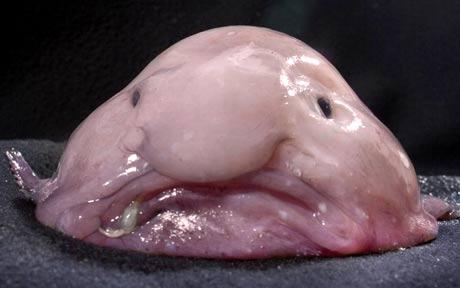
Blobfish


The Blobfish, also known as Psychrolutes marcidus, is a deep sea creature dwelling in the deep waters of Australia and Tasmania at a depth of 800m, thus it is rarely seen by humans.
Blobfish basically comprises of gelatinous mass (making them totally inedible). They have density lower than water, allowing them to float above the sea floor without needing to spend much energy. Their food sources comprise of any edible matters and living organisms such as crabs. Food sources that float around in  deep waters could be easily swallow down by the blobfish when they pass by it.


They may sound as though they are having a luxury life down in the sea, but in fact, the blobfish are facing a possible extinction. This is due to deep-sea fishing in Australia or Tasmania where the blobfish are caught in net as by-catch with other edible sea creatures such as crabs, lobsters etc.


These sad-looking creatures do have a sad life to begin with thus reflecting the big frown shown on their faces.
Lamprey

Lampreys, also known as lamprey eels, belong to the family of Petromyzontidae. The lampreys, the jawless fish, with circular mouth that acts as suction and teeth around the mouth and tongue; can be either parasitic (attaching to their hosts, mostly other larger fishes and sucking their blood) or non-parasitic.

Adult lampreys, ranging from 13 to 100cm, have no scales. The lamprey larvae, on the other hand, are blind and toothless. Most Lampreys inhabit around the coastal or fresh waters where the waters are cold or temperate, there are also some which live in the ocean. Some species such as the sea lamprey (Petromyzon marinus), have been observed to migrate from the ocean to fresh waters to spawn.

Unlike the Blobfish, lampreys are edible. Yes, there are people out there who find lampreys a delicacy, such as the people in ancient Roman and the upper classes throughout Europe during the Middle Ages.


To be frank, this is an "EXOTIC dish" that I’ll NEVER try even if it is highly appreciated by others. 


Anglerfish


Anglerfish, a type of fish belonging to the family of Melanocetus, can be found throughout the globe. Some Anglerfish inhabit in the open water (Pelagic) while some dwell under the deep sea (Benthic).


Anglerfish are generally dark gray to dark brown in color, having a huge head and enormous mouth with razor sharp, translucent teeth. They can range from three inches (7.5cm) to around four feet (120cm) in length, depending on the species and sex. They can be found throughout the world and inhabit at depths over 900m where sunlight is totally scarce and the water is freezing cold.


The distinctive feature owned only by the female anglerfish, is a dorsal spine that protrudes above their mouth like a fishing pole and having a luminous flesh (Esca) at the tip. Its purpose, to serve as a bait to lure preys close enough so that they can swallow them. What's more impressive is that the enormous mouth that they possess allow them to consume prey that is up to TWICE their own size!


The reproductive system of the Anglerfish is extraordinarily special. The male, which is much more smaller than the female has a completely different appearance. When a male angler matures, its digestive system will start to degenerate causing them to be unable to feed on their own. In order to survive, the male must search for a female or they would die due to starvation. Once the male has a found a female, it will bite into the her skin. Enzymes produce by the male angler will dissolve the skin of his mouth and that of the female's body, allowing them to fuse together. Once fused, the male will be part of the female's body (serves as a gonads) for the rest of its life like a parasite, getting all of his nutrients from her body. A female can have up to six males on her body at a time, allowing her to be ever-ready to spawn as the males on her serve as gonads to produce sperm.


Fangtooth

First look at it, I thought it was the anglerfish but actually it isn’t. Following closely behind at  the fourth place is the Fangtooth.


The fangtooth, belonging to the family of Anoplogastridae, can be found in temperate and tropical regions of the oceans. They inhabit in deep sea waters at depths of 200–2000m and can even go as deep as 5000m where the water is icy-cold. As food source is scarce in the deep waters where they live, fangtooths basically consume any food that floats around them.


Fangtooth, as the name implies, has sharp, fang-like teeth which encompass around its huge mouth. This allows the Fangtooth to swallow its preys with little chance for them to escape the deadly fangs. The difference between the Anglerfish and the Fangtooth is that the Anglerfish uses esca as a bait to lure its prey while the Fangtooth just wait for its prey to swim around it and take the chance to swallow them.


The spawning rate of the Fangtooths and the time taken for them to mature are actually uncertain. One thing for sure is that they are very slow growing and reside in the deep sea.
Given the ferocious-look, Fangtooth are actually harmless to humans due to their small size (grow up to a maximum length of only 16 centimetres). If so happen that you got a chance (which is usually rare) to run into one, don't worry, it will not swallow you, but it will definitely freak you out!

Frilled shark


Look at the fish at the right, is that an eel? 


The answer is NO! It’s a type of shark that has a body resembles to an eel. Here comes the Frilled Shark.


Frilled shark or Chlamydoselachus anguineus, belongs to the family of Chlamydoselachidae. It is distributed across the Atlantic and Pacific Ocean, but most of the catches come from the Japanese waters. Like the other fishes mentioned above, the frilled sharks also inhabit in deep waters at a depth of between 120 to 1500m.


The frilled shark, having a dark brown, eel-like body is very flexible. It has long flexible jaws which allow them to swallow their preys whole. Within the jaws, there are many rolls of small needle-like teeth to grip firmly and prevent its preys from escaping. Its diet, usually small sharks, fishes and squids that can be found in the waters.


The frilled shark is an aplacental viviparous species and its reproduction occurs oviparous (the eggs hatch in the body of the mother and emerge as young Frilled Sharks). The gestation period/hatching of the eggs takes about one to two years usually and can even go up to three and a half years. It has the longest gestation period among vertebrates (organisms having backbones). Due to the low reproductive rate of this species, accidental catches may threaten its numbers causing them to deplete and face the risk of being extinct. 

June 10, 2009

Meet the Alien In Deep Sea

Anglerfish is a type of very rare creature living in the deep sea. In most Anglerfish species, there is a long filament protruding out above the fish's eyes, at the tip of the filament there is an irregular growth of flesh (looks like a bulb, called esca). The long filament can move in all directions, while the esca acts as a bait to lure prey to the Anglerfish. When the prey is close enough, the Anglerfish will open its huge jaws and devour the prey whole! The Anglerfish can swallow a prey that is twice its own body size.


In some species of Anglerfish that lives deep under the sea where sunlight is scarce, the esca will emit light due to symbiosis with bacteria. The bacteria enters the esca, starts to multiply rapidly till their collective glow is bright enough to attract other fishes to become the prey of Anglerfish.

Here comes the interesting part, the reproduction of Anglerfish. As Anglerfish is extremely rare, it is very difficult to find a mating partner. In order not to become extinct, the Anglerfish has a very distinct way of reproduction.

At birth, the males are born with well developed olfactory organs (sensory system for smell). When the male Anglerfish mature, its digestive system starts failing, resulting in not able to feed independently. As a result, before the male dies from failure of digestive system, it has to find a female using its powerful olfactory organ. The male can detect pheromones from a mature female using its olfactory organ. So what will happen after the male found his mating partner?

After the male found a female, the male will bite into the female's skin, and digest the skin of his mouth and her body using a type of enzyme secreted. This will enable the couple to fuse with each other to the blood vessel level. The male then degenerates into a pair of gonads that parasites on the female. The gonads (male) release sperm in response to the hormones in the female's bloodstream signalling eggs release. This ensure that, whenever the female is ready to spawn, there will be sperm available to fertilise the eggs.

One of the species of Anglerfish, the little thing protruding
out at the back of the fish is the male that fused with the female

For the Anglerfish, the males reduce to parasites on females after maturation. The males are deemed to sacrifice in the reproduction system in this species, in order to ensure the survival of the species of Anglerfish.