Pages

December 13, 2011

The Insect that Creeps in the Night

Bedbugs

Have you ever wonder why every time you wake up in the morning, you would find yourself having red spots and itching all over? Isn't this very frustrating? 
If you are facing this problem, one possiblity might be bedbugs.

A bedbug in comparison with a grain of rice
Source: click here
Bedbugs also known as Cimex lectularius, belong to the family of Cimicidae. They are actually small parasitic insects that feed on the blood of warm-blooded animals.

Bed bugs are small and oval in shape bearing a darker brown when mature and reddish after feeding. Their lifespan varies from species to species and also from their feeding and they can grow up to 5mm in length and 3mm in width. They're able to crawl at a very fast pace to compensate not being able to fly.

Bedbugs dwell in areas of the home and as the name implies, they mostly inhabit in beds, including mattresses, bed frame etc. Bedbugs can survive in a wide range of conditions such as surviving at temperature as low as 16.1 degrees celsius or as high as 40 degrees celsius. They prefer feeding at night and hate the sunlight. However they will feed even in the day time when required. Bedbugs are attracted to to their hosts primarily by carbon dioxide (CO2), then by warmth. Bedbugs can live for up to a year without feeding but they will normally try to feed every few days unless conditions do not permit (making them able to survive in desolated areas).

After having some knowledge about the bedbugs, now let's talk about the symptoms of being bitten by them and the eradication of them.
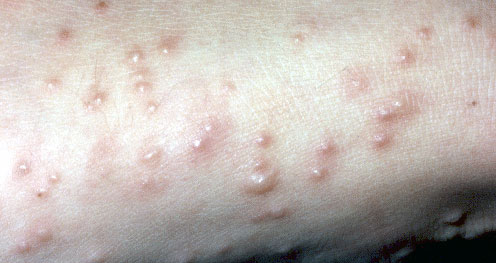
Source: click here
When you are bitten, the bitten area will turn red and become swollen, often accompanied with intense itching (normally caused by the saliva of the bedbugs). It is similar to a mosquito bite, red, swollen and itchy making it difficult to distinguish. You're tend to be bitten by bed bugs in a roll, normally 2 to 3 bites in a row. The possible reason is that the bed bugs are disturbed while feeding (turning over,scratching etc) making the bed bugs have to leave its host before returning back again to feed and biting on a different area. Another reason might be that it is trying to find a vein where it can get lots of feed (blood) from, thus trying several attempts to find the right spot.
The common symptoms as mentioned would be redness, swelling and itching at the area of the bite. In some rare cases, anaphylatic reaction may occur such as causing an asthma attack.

So how do you eradicate these nasty bugs??
Pesticides, vaccuumming and also high heat. Pesticides can be a real help to remove those bedbugs that have not been expose to pesticides before (not often seen nowadays) as there have been an increasing resistance to pesticides. So more people are opting for vaccuuming where bed bugs are. By vaccuuming every single corner of the house which is possible for it to inhabit or using high heat (above 46 degrees celsius), it is possible to leave your house bedbug-free. High concentration of carbon dioxide has been proven to kill bedbugs too!

December 7, 2011

The Ultimate Body Invaders

In the world of Nature, every organisms are trying very hard to win the game of survival. In order to win the game, some come up with an extraordinary method---to invade another kind and manipulate the host to create a condition favoring the survival of the invaders, while putting the hosts in great danger. The following are 5 ultimate body invaders that adopt the unique mechanism to ensure the survival of their species. 


Cordyceps 

Cordyceps invaded host. 
Cordyceps are fungi from the genus ascomycete fungi, among which there are a lot of different species. The fungus parasites on insects and different species parasites on different hosts. As the cordyceps fungus infects an insect host, its mycelium (fungus part) replaces the host's body tissues. The fruiting body of the fungus will eventually puncture the host body and protrude out to allow the release of ascospores (spores). Many of the times, during the development stage, the fungus manipulate its host such as controlling the insect to climb up a plant and attaches itself there before it dies, ensuring optimal dispersal of the spores of the fungus. Some cordyceps genus are proven to have medicinal properties.  


Paragordius tricuspidatus

Parasitic worm emerging out of cricket.
Paragordius tricuspidatus is well-known for manipulating behaviour of its cricket host. The eggs of this parasitic worms are laid at the river edges where the crickets reside. The microscopic size eggs are ingested by accident by the crickets, and hatch within. The larvae of the worm get nourishment from the host and grow, eventually filling the entire body cavity of the cricket. They can grow up to 10 - 15cm in lengths.  Upon maturation, the parasitic worms are ready to exit the hosts, the worms will induce an abnormal behavior to the cricket hosts --- to jump into the water. Most of the crickets will drown, while some will survive and lead a normal life after the excision of the parasites. After which, the worms will slither out and find its mating partners. The manipulation in behaviours are believed to be cause by a release of proteins that affect the Central Nervous System (CNS) of the crickets.  


Dinocampus coccinellae

Paralyzed ladybug guarding cocoons
Dinocampus coccinellae is a species of wasp that parasites on Ladybug. The female wasp lays one egg in the soft abdomen of the ladybug. After the egg hatches, the larva starts to consume the ladybug's eggs, then the gonads and the body of their host. However the ladybug host is still alive. When the parasites are ready to emerge, they paralyze the ladybug and tunnel out of its body. Then the parasites pupate in a cocoon attaching to the leg of the living ladybug, The ladybug's occasional twitching ward off any potential preys of the parasites,  making the ladybug the "bodyguard" of its parasites. A few days later, the wasps will emerge from the coccoon. 1 out of 4 ladybugs will recover from the paralysis and come back to health after all the cocoons have emptied.  


Leucochloridium paradoxum

Snail with infection.
Leucochloridium paradoxum, a kind of parasitic flatworm, infects a snail and alters the original behaviors and appearance of the snail; after which increasing the chances of the snail being eaten by a bird which is the next and final host of the parasite. To do so, the parasite resides into the translucent eye-stalks (preferably left one) of the snail, altering the normal eye-stalks into yellow-greenish stripes, inducing caterpillar mimicry. Birds do not usually snack on snail, however the altered eye-stalks of the snail, resembling a caterpillar results in birds mistakenly consuming the infected snails. The parasites also cause the snail to be more visible to the birds by making the snails stay under the sunlight instead of hiding in the shade.   


Myrmeconema neotropicum

Normal ants.
Infected ant with red gaster raise up high to mimic wild-berries. 
Myrmeconema neotropicum is tetradonematid nematode parasite that induce berries mimicry in tropical ants. The parasites mate and lay eggs inside the gasters (the hindmost abdomen) of the ants. The infected ants will develop bright red, egg-filled gasters that resemble red berries available in tropical forest. The parasites also cause the weakening of the exoskeleton linking the gasters to the rest of the body of the infected ants. The infected ants will walk with their gasters raise up high, allowing birds to mistaken them as wild berries and pick up the gasters which detach easily from the ant.The parasite eggs will be passed in the birds' dropping and later collected by the tropical ants again.  

Buruli Ulcer - Infection that Consumes Skins

Buruli Ulcer is a disease caused by infection by the Mycobacterium ulcerans. It is one of the most neglected disease in the world, specifically in the developing countries. Mycobacterium (other bacteria of the same family) is also the bacteria that causes tuberculosis and leprosis; however, Buruli ulcer has received the least attention.

Infection of this disease occurs mainly in tropical areas such as Australia, West Africa, Southeast Asia and New Guinea. Among which, this disease has the largest impact in developing countries, mainly due to the lack of knowledge in the disease.

It has been reported that the mycobacteria strives within aquatic environments (such as small aquatic animals, biofilms). Transmission mode to humans is still under investigation. Thus, Buruli ulcers usually occurs near water sources, infecting children under 15 years mainly. There is no evidence that this disease can be transmitted from person to person.

A young boy with Buruli ulcers
Picture Source: click here


Symptoms in General

Buruli ulcer begins with a painless mobile swelling in the skin (any part of the body). The more severe infection can be painful. Buruli ulcer is a long term, necrotizing disease that slowly destroys the skin and soft tissue by the toxin secreted by the mycobacteria.Without treatment, massive ulcerations take place and if the bone is affected, gross deformities will be the consequence.  If the ulcers develop on the limbs, the movement of the patients will be greatly restricted; even after the lesions have healed, the massive scarring will affect the mobility of the patients. In more severe cases, lifetime disabilities are norm in the patients. Can you imagine the pain the patients are enduring?


Treatment And Prevention

The most efficient treatment of Buruli ulcer is the surgical removal of the ulcers. For disease in more advanced stage, prolonged treatment with skin grafting will be necessary. However, surgical practice is scarcely available in developing countries. A combination of antibiotics can be used to reduce the requirement for surgery.

Bacille Calmette–GuĂ©rin (BCG) vaccination has been observed to provide short-term protection against the disease. Although only limited protection is available, it will still be useful by ensuring a complete coverage of this vaccine in the heavily affected regions. Once again, people in developing countries have very minor chances to receive such vaccination due to extreme poverty as well as lack of knowledge in diseases.